My OSWP Journey: From College Wi-Fi Experiments to Finally Getting Certified
How I went from messing with wifite in college to passing the OSWP exam: prep resources, exam tips, and why real corporate Wi-Fi pentesting is nothing like the cert.
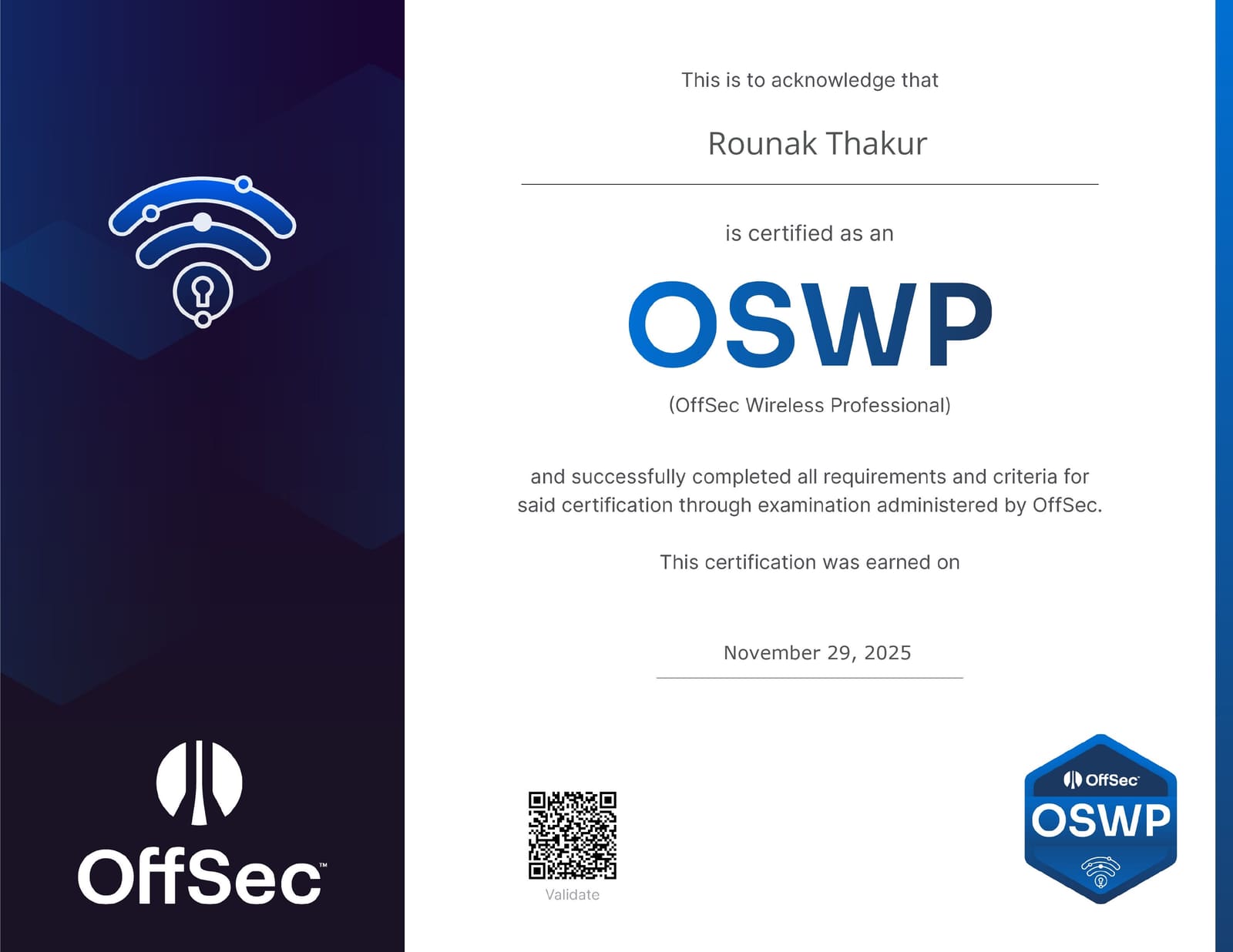
My wireless security interest started in college, where I experimented with tools like wifite and fern-wifi-cracker without fully understanding the underlying mechanics. That early hands-on tinkering taught me the basics: handshakes, initialization vectors, deauthentication packets, enterprise authentication systems.
Years later, after earning OSCP, CPENT, and CEH, I discovered OSWP was bundled free with my OneLearn subscription. That was all the motivation I needed.
Why I Even Attempted OSWP
Three reasons:
- The cert came free with my existing subscription
- I had genuine interest in wireless security from my college days
- I wanted formal validation of skills I’d already been using in practice
My Prep Journey
1. Light Skim Through the Official OffSec Material
I used the course material as a structured review, not a deep study. It covered:
- WPA/WPA2 handshake procedures
- Enterprise PEAP/MSCHAPv2 attack methodologies
- WEP attack vectors
- wpa_supplicant configuration and usage
2. The Real MVP: WiFiChallenge.com

This was the most valuable prep resource by far. Realistic simulations with:
- Controlled attack environments
- Realistic client reconnection behavior
- Deauthentication responses
- Evil twin network behavior
- Enterprise EAP packet captures
What I practiced there:
- WPA/WPA2 handshake capture
- ARP replay techniques for WEP networks
- NETNTLM cracking
- wpa_supplicant connection workflows
3. The Cheatsheets I Actually Used
Quick reference over memorization was the approach.
My Exam Experience

The exam was methodical and predictable:
- First network: ~10 minutes
- Second network: ~30 minutes
- Third network: ~1 hour
It rewards methodology, not brute memorization.
Challenges That Tested My Patience
1. RDP Lag
RDP connections were noticeably slow. Switch to SSH immediately. The difference in terminal responsiveness is dramatic.
2. Technical Glitches Are Real
Exam machines can malfunction. I had one instance that required a revert. Don’t spend exam time troubleshooting infrastructure. Just revert and move on.
3. Notes Will Save You
Despite prior experience, having reference docs made a real difference:
- wpa_supplicant config templates
- hostapd-wpe setup steps
- Common airodump-ng and aireplay-ng flags
- WEP replay attack sequences
These shaved minutes off every attack and kept execution consistent.
4. The Exam Is Straightforward
No surprises. Know these and you’ll pass:
- Monitor mode activation
- Handshake capture
- Evil twin attack deployment
- wpa_supplicant operation
- Enterprise EAP packet capture
- WEP IV generation
The Reality Check: Real Corporate Wi-Fi Pentesting Is NOTHING Like OSWP

OSWP gives you a solid foundation, but enterprise wireless is a completely different game.
OSWP Techniques Don’t Work on Real Corporate Wi-Fi
The attacks OSWP teaches are largely ineffective against modern enterprise deployments:
- Deauthentication attacks
- WPA2-PSK handshake capture
- Evil twin deployment
- ARP replay
- Offline password cracking
Modern enterprises counter all of this with:
- WPA2-Enterprise and WPA3-Enterprise
- 802.1X with EAP authentication
- RADIUS + Network Access Control
- Controller-based APs (Cisco, Aruba, Meraki, Ruckus)
- Rogue AP detection systems
- Protected Management Frames (802.11w)
- Deauth/disassociation frame filtering
- Certificate-based EAP-TLS
Your deauth? → Auto-ignored. Your injections? → Flagged as attacks.
How Corporates Actually Secure Wi-Fi
Real enterprise wireless typically includes:
- EAP-TLS with device-level certificates
- RADIUS enforcement via Cisco ISE or Aruba ClearPass
- WIPS/WIDS (Wireless Intrusion Prevention/Detection)
- SSID segmentation (corporate, guest, IoT, employee)
- Dynamic VLAN assignment based on auth
- Device compliance checks (AV status, OS version, domain membership)
How Much I Actually Studied
Pragmatic, not exhaustive:
- WiFiChallenge labs
- OSWP course material review
- ChatGPT for quick clarifications
- Heavy reliance on college-era wireless experience
OSWP is not designed to be a deep research cert. It’s about executing clean, repeatable attacks.
Who Should Consider OSWP?

It’s a good fit if you:
- Want foundational wireless security knowledge
- Prefer hands-on exam formats
- Are a pentester expanding your skill set
- Have it bundled with an existing OffSec subscription
It’s not going to teach you modern corporate wireless exploitation, but it’s a perfect foundation to build from.
Final Thoughts
Coming full circle from college Wi-Fi experiments to a formal OffSec cert felt genuinely satisfying. OffSec material + WiFiChallenge + a few solid cheatsheets is all you need to breeze through the exam calmly and confidently.